S&OP, meaning sales and operations planning.
Agri S&OP is a structured planning process used in the agricultural sector to align demand and supply.
It helps companies make informed decisions by integrating input from sales, production, finance, and supply chain - while accounting for the unique challenges of agriculture like seasonality, quality, degeneration, perish-ability and weather dependency.
Flex²B plays an important and central role in the process, as it holds information on quality, stock, lifetime and it can interact with 3PL systems to get information on the demand, supply etc by integrated mechanisms between the agronomist application, ERP application.
A visualization on production demand, splitting, resource assignments can be done through the web based planning tool.
What resources can be used for S&OP?
- Agronomist, farm, field management solutions (via Flex²B server side interface)
- Quality, risk, rating,... data (in Flex²B itself or via Flex²B server side interface)
- ERP systems (via Flex²B server side interface)
- Data Analysis tools, BI tools ( DFR, PowerBI,...)
- The SC solution (Flex²B , complete solution)
- Production planning interface, (via Flex²B Cloud interface)
- Production line automation solutions (via Flex²B server side interface)
How does the Process Work?
1. Cross-functional Collaboration
The process brings together key departments:
- Sales: forecasts market demand.
- Production/Growing: plans crop cycles or livestock production.
- Inventory Management: considers shelf life and storage capacity.
- Finance: evaluates profitability and cost implications.
- Procurement: ensures timely sourcing of inputs like seeds, feed, or packaging.
2. Demand Planning
- Based on historical sales data, market trends, contracts, and weather forecasts.
- In agriculture, demand planning is more complex due to unpredictable yields and seasonal demand spikes.
3. Supply Planning
Takes into account:
- Crop or livestock growth cycles.
- Availability of land, labor, and resources.
- Expected yields (e.g., tons per hectare).
- Losses due to pests, diseases, produce loss, quality loss or external events.
4. Balancing Demand and Supply
Scenario planning is key: What if the harvest is lower than expected? What if demand surges?
Decisions may include:
- Adjusting production volumes.
- Buying or selling surplus.
- Using storage strategies (e.g., freezing, processing, stock optimisations, lifetime cycle enhancement, conditioned environments...)
5. S&OP Cycle
Typically weekly, monthly or seasonal.
Involves several steps:
- Data gathering
- Demand planning
- Supply planning
- Pre-S&OP meeting (review and alignment)
- Executive S&OP meeting (final decisions)
!! Unique Challenges in Agriculture
Perish-ability: Products often have short shelf lives.
External dependency: Yields can vary significantly.
Seasonality: Both production and demand fluctuate.
Contract farming: Agreements with growers must be honored.
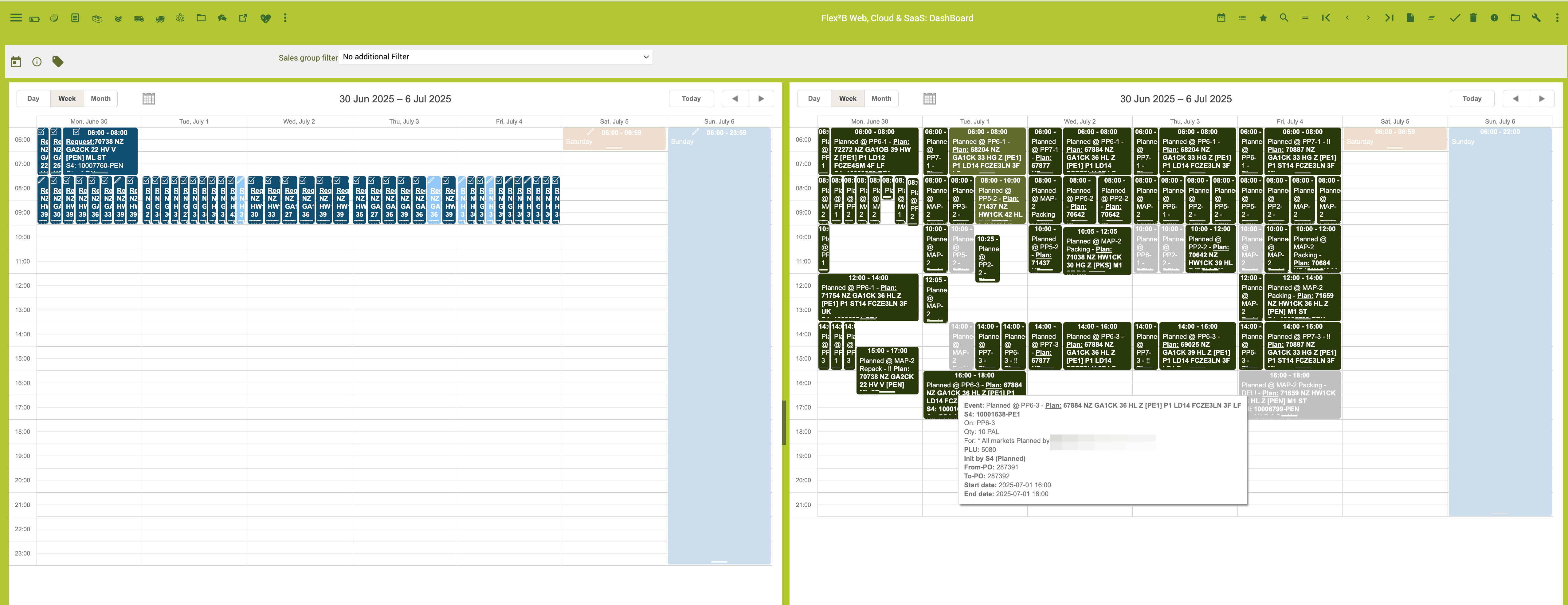
An example from the Flex²B Web Application for production planning:
On the left, you see the production demand, on the right, you see the according splitting to assign production batches and production resources. The demand request, process was in the below case posted by a SAP4 CPI (ERP) posting.
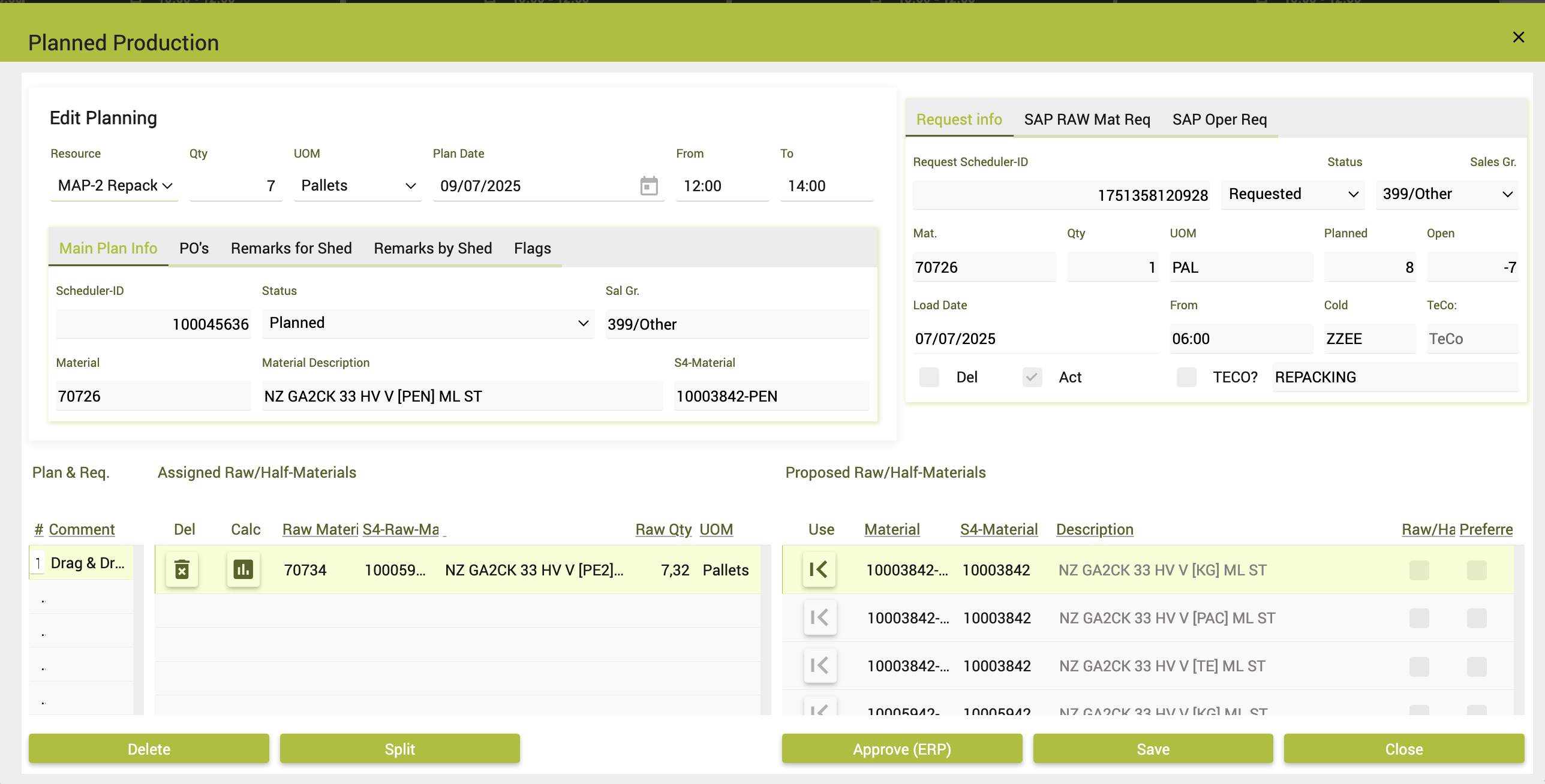
An individual production planning has a set of characteristics. A preview could be: